My research combines first-principles calculations and machine learning to understand core-loss spectra and the atomic-scale dynamics of two-dimensional ferroelectric materials.
I study how core-loss spectra encode local electronic structure, and how to make their theoretical description more consistent with experiment. My work follows two connected directions: interpreting spectra through machine learning, and correcting systematic discrepancies in excited-supercell core-hole (XCH) calculations.
Learning from physically meaningful energy windows
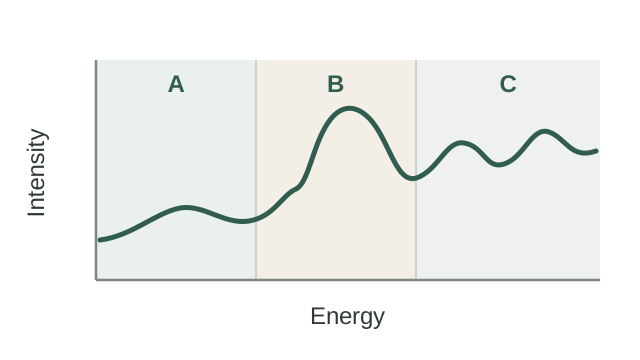
Energy windows. Different spectral regions provide different information for model learning; the windows and curve shown here are illustrative. Conceptual schematic · click to enlarge.
Using doped graphene as a model system, I apply region-resolved machine learning to X-ray absorption near-edge structure (XANES) spectra. I examine how different physical energy windows contribute to model learning and provide physical explanations for their differing predictive performance. This connects the information learned by a model with the underlying spectral features and dopant-induced changes in electronic structure.
Related paper
Decoding Dopant-Induced Electronic Modulation in Graphene via Region-Resolved Machine Learning of XANES
Two systematic discrepancies motivate my correction work: underestimated separations between absorption peaks, and underestimated absolute transition energies, which also affect chemical shifts. I address these problems with complementary approaches.
Correcting absorption-peak separations with machine learning
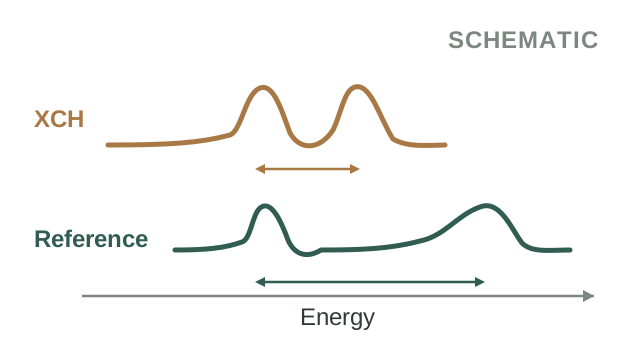
Relative energy scale. The separation between absorption peaks is the target of this machine-learning correction. Conceptual schematic · click to enlarge.
XCH calculations can underestimate the energy separations between absorption peaks, producing a systematic mismatch with experimental core-loss spectra. I use machine learning to correct this discrepancy and improve agreement between simulated and measured spectra. This work focuses on the relative energy scale within a spectrum, complementing the absolute-energy correction below.
Related paper
Systematic correction of core-loss spectra via machine learning: bridging the gap between simulated and experimental spectra
Correcting absolute transition energies with a single-atom reference
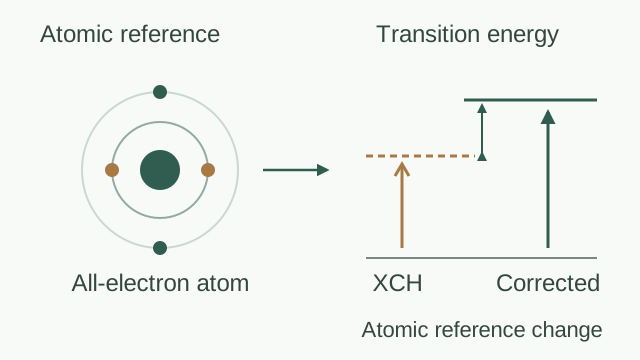
Absolute energy scale. A single-atom reference contribution complements the supercell response; no numerical energies are shown. Conceptual schematic · click to enlarge.
Fixed-reference PAW-XCH calculations can underestimate absolute transition energies and, consequently, chemical shifts. I address this using an all-electron single-atom reference based on core-electron total-energy calculations. This approach targets the absolute energy scale and the differences between chemical environments, supporting more consistent comparisons between calculated and experimental core-loss spectra.
Related paper
All-Electron Single-Atom Reference Correction for Absolute Transition Energies in Fixed-Reference PAW-XCH Calculations
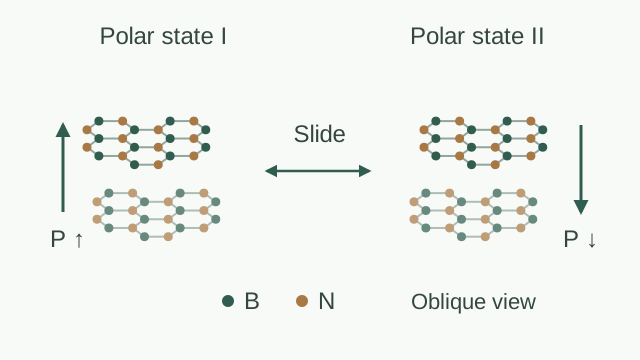
Sliding ferroelectricity. Relative motion between parallel h-BN layers connects opposite polar states. Atomic positions, displacement, and polarization are not to scale. Conceptual schematic · click to enlarge.
My research explores sliding ferroelectricity in bilayer hexagonal boron nitride. I use deep-learning interatomic potentials and molecular dynamics to investigate how relative motion between the layers is connected to polarization reversal.
I am particularly interested in the atomic-scale dynamics of switching and its electromechanical response, including both single-domain and domain-wall configurations. These simulations help connect local atomic motion with the mechanisms of ferroelectric switching in two-dimensional materials.
Related preprint
Ultrafast Sliding Ferroelectric Switching in Bilayer Hexagonal Boron Nitride Revealed by Deep Learning Molecular Dynamics